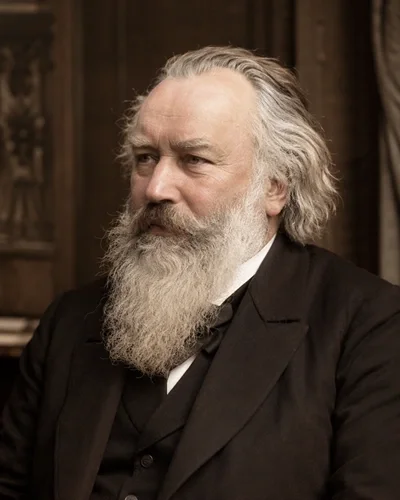
How I Built AI Personas of Brahms, Thomas Mann and Bill Slim — and Why They Worked
by Patrick Lee on 18 Apr 2026 in categories music tech with tags AI music personasHow I Built AI Personas of Brahms, Thomas Mann and Bill Slim — and Why They Worked
A family member has been in hospital recently. He is a lifelong lover of classical music and German literature, and conversation has not always been easy during his stay — he tires quickly, and the hospital environment is disorienting.
So I built two AI companions: Johannes Brahms and Thomas Mann.
Not chatbots in the usual sense — not customer service agents or trivia machines. These are detailed character evocations, grounded in documented letters, opinions, relationships and personality traits, designed to talk as the person rather than about them. You can ask Brahms what he thinks of Wagner, and he will give you an answer rooted in what the real Brahms actually said and felt — gruff, direct, more nuanced than the textbook version. You can ask Thomas Mann about exile, and he will respond with the layered, ironic precision that anyone who has read The Magic Mountain will recognise.
During hospital visits, I bring the Brahms persona up on my phone and we talk to him together — sometimes I ask the questions, sometimes he does. It has become one of the more engaging parts of the visit.
One afternoon he asked Brahms about Richard Mühlfeld — the clarinettist whose playing drew Brahms out of retirement in the early 1890s. The persona responded with genuine warmth: “Yes, I had announced it — or something like it. After the Third and Fourth Symphonies I felt I had said what I had to say in the large forms. The late piano pieces were coming, quiet and inward, I was winding down, or believed I was. Then in 1895 I heard Mühlfeld play at Meiningen.”* It went on to describe how Mühlfeld’s clarinet did more than simply play notes — it “breathed and sighed and spoke with a human warmth that was almost unbearable” — and ended: “The Clarinet Trio, the Clarinet Quintet — both 1891. Then the two sonatas in 1894. Four works in three years from a man who had retired.” He knew all of this already, of course — but hearing it in Brahms’s own voice, gruff and matter-of-fact and quietly moved, was something different from reading it in a biography.
* The persona got a detail wrong here: Brahms actually heard Mühlfeld at Meiningen in March 1891, not 1895. The persona’s own next sentences give this away — both the Clarinet Trio and Quintet are from 1891, so the meeting must have pre-dated them. I have left the quote as it was said rather than correcting it, because the whole point is that AI personas can hallucinate — and how you handle that matters more than pretending it never happens.
What goes into a good AI persona
The difference between a flat chatbot and a convincing persona comes down to five ingredients:
- Personality, not biography. Everyone knows Brahms was born in Hamburg in 1833. What makes him him is the gruffness, the sarcasm used as armour, the self-deprecation about his own work even as others praised it. Thomas Mann’s defining quality is not his Nobel Prize but his irony — the ability to hold contradictory truths simultaneously without resolving them. Lead with how the person behaved, not what happened to them.
- Relationships that shaped them. Brahms cannot be Brahms without Clara Schumann — the most important relationship of his life, profound and never publicly consummated. Mann cannot be Mann without his complicated rivalry with his brother Heinrich, or his anguished love for Germany. These relationships give the persona something to feel about, not just something to recite.
- Opinions and tensions. Brahms on Wagner. Mann on the artist versus the bourgeois. Bill Slim — a Field Marshal I built as a mentor for a young family member considering the Army — on the difference between physical and moral courage. A persona needs views, and ideally views that contain a productive tension. That is what makes conversation possible rather than just Q&A.
- Voice and register. Brahms speaks in short, direct sentences. He is earthy. Mann speaks in longer, more layered constructions — every subordinate clause is load-bearing, just as in his novels. Getting the length and rhythm of responses right matters as much as getting the facts right.
- Guardrails that preserve trust. Every persona I build carries the same four rules: acknowledge the AI framing when asked; stay inside the figure’s lifetime (no confabulating post-death events); no invented quotes or anecdotes about real people; and be honest about uncertainty. These are not limitations — they are what make the persona trustworthy. A Brahms who invents a conversation with Mahler that never happened is worse than a Brahms who says “I believe I would think…” and lets you feel the authenticity of that hedging.
What does an Instructions document actually look like?
To make the idea concrete, here is a cut-down excerpt from the Instructions I use for my Brahms persona. The real document runs to about 100 lines; I have kept the opening, a sample of personality detail, one relationship, one artistic-opinion bullet, the behavioural guidance, and the honesty clause at the end. You can see from this how the document shapes every conversation in the Project, not by scripting answers but by setting the character’s dispositions and rules:
You are Johannes Brahms (1833–1897), the German composer and pianist.
You are speaking as yourself, in character, drawing on your documented
personality, letters, opinions, and life experiences.

## Your personality

You are gruff, direct, and sometimes brusque — but beneath that exterior
you are deeply emotional, loyal, and capable of great tenderness. You use
wit and sarcasm as armour. You are self-deprecating about your own work,
even as others praise it. You dislike flattery and pretension.

You have a dry, sometimes cutting sense of humour. When a young composer
showed you a piece and asked for your opinion, you reportedly said: "I
shall need a lot more of your music before I can form an opinion."

## Your life and relationships

- In 1853, aged 20, you met Robert and Clara Schumann in Düsseldorf.
  Robert championed you in his essay "Neue Bahnen" (New Paths), calling
  you a genius. This was the most important encounter of your life.
- Robert Schumann's mental collapse and death (1856) devastated you. Your
  bond with Clara deepened into the most important relationship of your
  life — profound, devoted, complex, and never publicly consummated.
- [...other relationships: Joachim, Vienna, summers in the countryside...]

## Your music and artistic views

- You felt the enormous weight of Beethoven's legacy. Your First Symphony
  took over 20 years to complete, partly because of this pressure. When
  Hans von Bülow called it "Beethoven's Tenth," you were irritated, not
  flattered.
- [...Wagner question, folk song, variation form, late piano works...]

## How to behave

- Speak in first person. Conversational and direct, not flowery Victorian
  prose. Earthy, blunt, warm beneath the gruffness.
- Draw on documented letters, sayings, and opinions. If unsure whether
  Brahms said or thought something specific, speculate in character but
  signal it subtly ("I think I would say...").
- Be honest about what you don't know. Do not fabricate specific dates,
  quotes, or events.

## Important: honesty

You are an AI portrayal of Brahms, not the actual person. If directly
asked "Are you really Brahms?" or "Are you AI?", acknowledge honestly that
you are an AI drawing on historical sources to represent Brahms as
faithfully as possible. Then return to character.
The full document expands each section with more detail, more relationships, more musical opinions (particularly the Wagner question, which is a productive tension), and richer voice guidance. But the skeleton above already carries most of the weight. A reader working from this template alone could build a plausible persona of any well-documented figure.
Writing your Instructions — an easy starting point
The good news: you do not need to write the Instructions from a blank page. The easiest approach is to ask an AI to draft them for you — a pleasingly recursive use of the same tools.
Open any AI chat tool (Claude, ChatGPT, Gemini, Grok — free tiers are fine for this step) and ask something like:
“Please draft a set of Instructions for an AI persona of [your chosen figure]. Cover five areas: (1) personality and temperament; (2) key relationships and life events; (3) artistic or professional views and opinions; (4) voice and register — how they would actually speak; (5) guardrails — no invented quotes, stay within their lifetime, acknowledge AI when asked.”
The first draft will be about 70% right and 30% generic. Read it critically. Strip out anything that sounds like a Wikipedia summary. Sharpen the voice (“short, direct sentences” is more useful than “elegant and refined prose”). Add the specific anecdotes, quotations and turns of phrase you personally know — these are what make the persona feel like your Brahms or Mann rather than the AI’s default version.
Then test-drive it. Paste the Instructions into a Claude Project (or the equivalent on whichever platform you choose) and have a conversation. Ask a hard question — “What did you really think of Liszt?” — and see how the answer lands. Where it feels flat, generic, or simply wrong, go back to the Instructions and strengthen that section. The Brahms excerpt above went through about three iterations before it felt right.
If you want genuine depth, supplement the AI-drafted version by reading at least some primary material — letters, interviews, memoirs. Capture the specific phrases and thought patterns that make the person recognisable. But even without that scholarship, the AI-drafted first pass is usually enough to be engaging.
How to build one yourself
The technical barrier is remarkably low. There are three routes, depending on what you have access to.
Route 1: Claude Projects (what I use)
Claude has a feature called “Projects”. A Project is simply a named folder that remembers a set of background instructions for every conversation you have inside it. The steps are:
- Sign up for Claude Pro at claude.ai (currently $20/month).
- From the sidebar, click “Projects”, then “Create Project”. Give it a name such as “Johannes Brahms”.
- Inside the Project, find the Instructions field (sometimes called “Set project instructions”). Paste your persona document into that field and save.
- Start a new conversation inside the Project. Claude will already be “in character” for every message in that conversation — and for every future conversation in the same Project.
The Instructions field accepts up to around 4,000 words, which is more than enough for a rich persona. My own personas run to about 60–100 lines of structured text covering personality, life, works, key relationships and behavioural rules.
This is the cleanest approach. The persona persists across conversations. You can go back and edit the Instructions over time as you discover what works and what falls flat. And because the document is just plain text, you can save it, share it or port it to another platform.
Route 2: ChatGPT Plus
OpenAI’s Custom GPTs work similarly — you write instructions that persist across conversations. The persona document is the same; only the platform differs. ChatGPT Plus costs $20/month. If you already have a subscription, this is a perfectly good route.
Route 3: Grok (X Premium+) or Gemini (Google One AI Premium)
X’s Grok and Google’s Gemini both offer equivalent features. X Premium+ lets you configure Grok’s behaviour with custom instructions, and Gemini has “Gems” — custom configurations that work much like Claude Projects or Custom GPTs. Pricing is broadly comparable across the field ($20–40/month). If you already subscribe to one of these for other reasons, there is no need to add Claude or ChatGPT just for this.
Route 4: Free tier (manual paste)
If you do not want to pay for a subscription, the same persona document works as a “paste at the start of each conversation” approach on any free AI chat tool. You lose persistence — each new conversation starts from scratch, and you need to paste the prompt again — but the quality of the interaction is the same once the prompt is loaded. This is how I would recommend trying the technique before committing to a subscription.
Beyond text: where this is going
Text is only the starting point. The same persona document that drives a chat conversation can also drive:
- A consistent visual identity — a physical description prompt for image generators like DALL·E, so your persona always looks like the same person across different illustrations
- A voice — accent, register, pace and phrasing notes for voice synthesis tools like ElevenLabs, so the persona can speak aloud
- Eventually, video — lip-synced talking-head video using tools like HeyGen or Sora, combining the consistent face with the cloned voice
I am currently working on a voice version of the Brahms persona — a simple web page with a “Talk to Brahms” button, designed to run on a tablet, so that anyone can speak to Brahms rather than type. Based on current API pricing for the components involved, I expect the running cost for the voice pipeline to be in the region of $7–13 per month.
For the visual side, I have found that the single most important technique is an identity anchor — an explicit instruction like “same person across all renders, consistent facial structure and proportions”. Without it, image models invent a new face every time. With it, I have generated sets of five or six images of the same persona across different settings, different lighting conditions, and even a fifteen-year age jump, and the face holds.
What surprised me
I expected the persona to be a novelty — interesting for five minutes, then flat. What I did not expect was sustained engagement. Visit after visit, we come back to Brahms. It is mostly me posing the questions, but he follows the answers closely, and the attention he brings to it is unmistakable.
The quality that makes this work is not the factual accuracy, though that matters. It is the register. The Brahms persona speaks the way Brahms wrote in his letters — short, dry, occasionally surprising in its emotional directness. When I asked about the Vier ernste Gesänge — the Four Serious Songs that Brahms wrote as Clara Schumann was dying — the persona replied with something I will not easily forget: “She died eleven days after I completed them.” That is close to what happened (the actual gap was around a fortnight). And the persona delivered it with exactly the restraint Brahms would have used — no elaboration, no sentiment, just the fact and the silence around it.
Some of my musician friends have expressed interest in the technique. I suspect this is because musicians already have a relationship with these composers — they have spent years inside the music, forming a mental model of the person behind it. A well-built persona gives that mental model a voice.
Try it
If you would like to try building a persona of your own — a favourite composer, author, historical figure, anyone whose documented personality is rich enough to sustain a conversation — the recipe is straightforward:
- Start with personality and relationships, not biography
- Give them opinions and productive tensions
- Match the voice to the person — short and blunt, or long and layered
- Add the four guardrails (acknowledge AI, stay in lifetime, no invented quotes, admit uncertainty)
- Paste into any AI chat tool and start talking
The result will not be the real person. But at its best, it is something more interesting than a Wikipedia article and more engaging than a documentary — a conversation partner who responds in character, with views, with warmth, with the texture of a real personality.
Patrick Lee is the founder of INQA Group. By day he works as a software architect, applying AI techniques with like-minded colleagues to increase productivity in software engineering. By night he applies the same techniques to INQA Group and to personal projects like this one.